Review: Girls’ Day 2026 – AI, you and the world of tomorrow
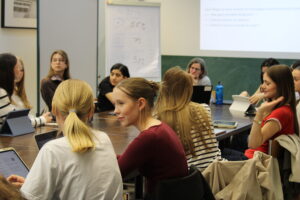
What does it mean to use AI responsibly, and who gets to ask that question? On April 23, 2026, the Center for Responsible AI Technologies participated in the Girls‘ Day 2026 at the Hochschule für Philosophie München, bringing these questions into a room full of young women encountering them, in many cases, for the first time. The day was jointly organised by DeepTech Collective e.V. and the Munich Centre for Machine Learning (MCML), with CReAITech contributing two of the five workshops that day. Under the theme „KI, du und die Welt von morgen“ (AI, you and the world of tomorrow), the event offered the students hands-on access to the ethical, legal, and societal dimensions of artificial intelligence.
AI Literacy – Responsibility, Impact & Ethics
Led by Prof. Julia Inthorn (HFPH | CReAITech), this session invited participants to look past the interface and examine what actually happens when AI systems are put to use. The workshop addressed questions that rarely surface in everyday AI discourse: What does data processing involve, and who bears its costs? How can AI use affect the way we think, feel, and relate to technology? And why does „legally permitted“ not automatically mean „fair“? A central concept running through the session was the Eliza effect, which describes the human tendency to attribute understanding and empathy to AI systems and what that tendency reveals about the relationship between people and machines. Ecological dimensions of AI use were also brought into view, giving participants a more complete picture of the conditions under which these technologies operate.
AI, you and the world of tomorrow
Samira-Isabel Landgraf (Chair for Law, Innovation and Legal Design | TUM), Philipp Mehl (TUM | CReAITech), and Anna Maria Planegger (TUM | CReAITech) opened their session with a deceptively simple question: when you draw something, does it belong to you? Participants began by sketching their own drawings, which were then photographed and fed into an AI system. The group watched as their work was transformed into new visual styles, from animation to Pixar-style 3D to oil painting, before being asked to reflect on what remained theirs in the result. This exercise formed the basis for a discussion of copyright law, explained accessibly and without simplification, covering what the law protects, where it currently leaves AI in a grey zone, and why a single click of „I agree“ can carry more legal weight than most users realise. The workshop closed with a moment of collective reflection, asking participants to consider what they would choose to share in the future and what they would rather keep to themselves. The central message, formulated by the participants themselves, was that creative ideas have value and that self-determination in how they are shared is worth protecting.
Conclusion
Girls’ Day 2026 demonstrated that questions about responsible AI are neither too abstract nor too technical for a general audience, including one encountering them for the first time. By embedding these discussions in hands-on formats, CReAITech’s contributions made the connections between everyday AI use and broader ethical and legal structures visible. Engaging the public, and especially the next generation, in these conversations is not peripheral to CReAITech’s mission. It is central to it.
Thank you to the Munich Center for Machine Learning (MCML) for contributing the images.