Review: Workshop ›Critical Theory of the Computational‹
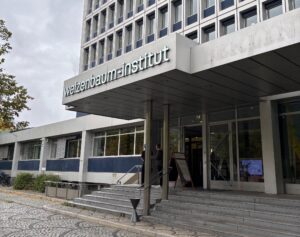
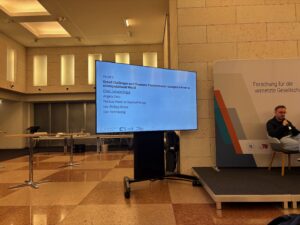
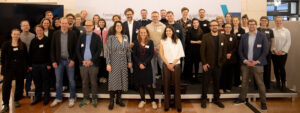
What do critical thinking and emancipation mean in the age of generative AI? These and other fundamental questions were the focus of the two-day workshop “Critical Theory of the Computational”, which took place on October 16 and 17, 2025, at the Weizenbaum Institute in Berlin. The conference was jointly organized by the Weizenbaum Institute, the Center for Responsible AI Technologies—represented by Benjamin Rathgeber—and the Center for Critical Computational Studies (C3S) in Frankfurt. The Munich School of Philosophy was also represented at the conference in terms of content: In their contribution “Behind the Hype: A Critique of Artificial Reasoning,” Raphael Ronge, Markus Maier, and David Gierscher critically analyzed so-called “reasoning models” from a philosophical-technical perspective.
Conceptual framework: Emancipating emancipation
Hosts Christoph Burchard and Juliane Engel opened the conference with four central provocations that set the theoretical framework for the following discussions. Their starting point: Emancipation in the digital age has itself become a control mechanism that makes us readable. Therefore, emancipation itself must be emancipated. Freedom should not be understood as autonomy, but as a practice of relation, openness, and incompleteness.
Criticism, according to the organizers, must be understood as a situated practice—not limited to interruptive, deconstructive practices, but also encompassing prefigurative, compositional approaches. To this end, the computational must be thought of in terms of time, space, and matter: it is as much aesthetics as it is technology. Criticism today has become a signal for the next update—demystification no longer breaks the system—if we do not focus on the transformation of transformation. What is needed, therefore, is a criticism that is aware of its own entanglement and appropriation, but nevertheless does not give up. Bringing this concept to life should be the focus of the next two days.
A New Critical Theory?
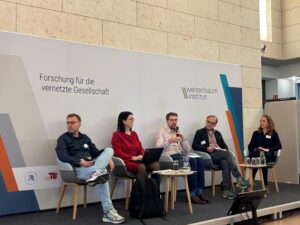
The following six panels—interdisciplinary and featuring high-profile participants—were intended to provide a discursive starting point for the development of such a critique. The panelists examined how technological and algorithmic capitalism is transforming knowledge, labor, and power relations, thereby creating new forms of domination and dependency. In keeping with the spirit of the conference, they emphasized that critical theory and political reflection must keep pace with the speed and complexity of digital structures in order to preserve rationality and critical thinking. At the same time, the panels questioned how, for example, large language models reshape or reinforce sustainability narratives, legal structures, democratic practices, and capitalist conditions—with far-reaching consequences for democracy, justice, and social self-determination. And how these must therefore be repeatedly examined and questioned.
Model Collapse – Keynote by Kate Crawford
At the end of the first day, Prof. Kate Crawford gave a keynote speech on the topic of “Model Collapse.” She developed a metabolic cycle of absorption, processing, and excretion of (synthetic) data, which not only destabilizes AI models but also litters our digital worlds while destroying planetary resources at an ever-increasing rate.
Conclusion
In his closing remarks on the second day, Thorsten Thiel emphasized that there is a need for a Critical Theory (with a capital C) of the computational – but perhaps even more important are contemporary critical (with a lowercase c) theories of the computational. Based on the original critical theory, critical theoretical approaches can and must be developed as practice. These must be able to meet the challenges of the computational age, while constantly questioning and reflecting on the conditions of their own possibility under digital auspices. Only in this way can we find ways to create frictions that elude a reductionist myth of optimizability.
Authors: Markus Maier & Raphael Ronge